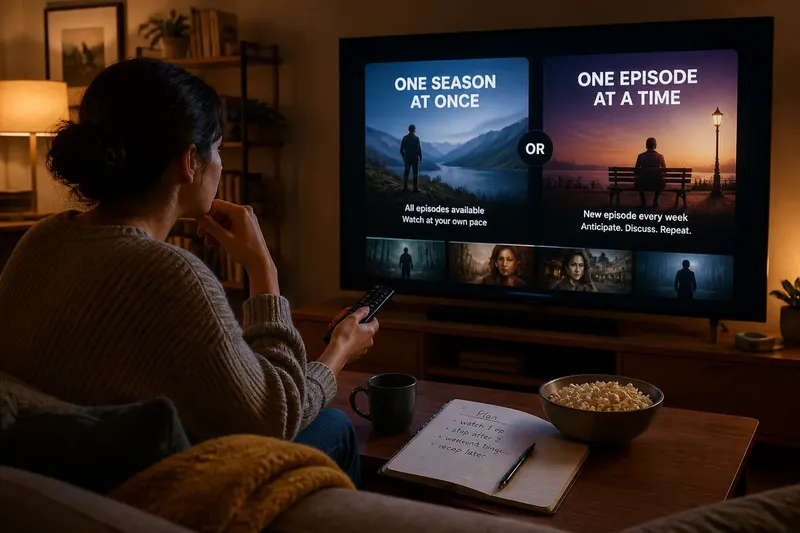
From Scheduled Broadcast to the On-Demand Library
Trace the shift from scheduled broadcasts to on-demand libraries and see how each model changes when you watch, what you can choose, and how you find it.
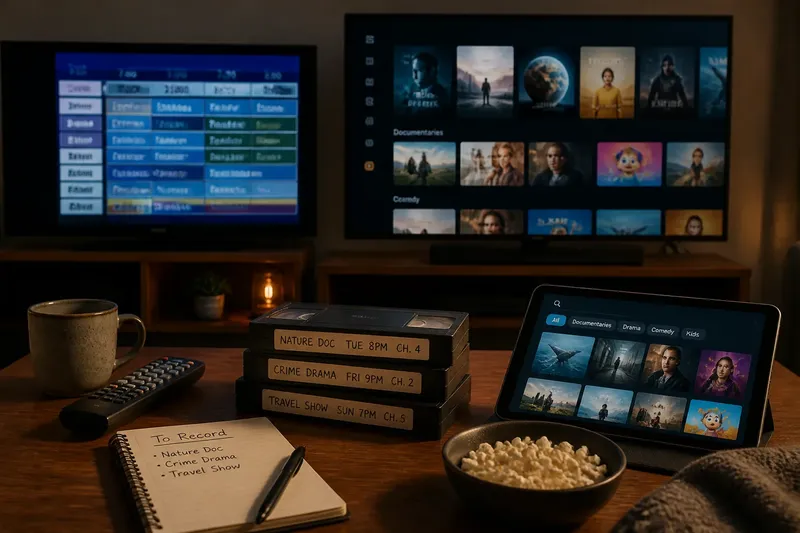
The most common mistake in explaining the shift from scheduled broadcast to on-demand library is to call it a simple move from old television to new television. That shortcut obscures the practical change: viewers gained a different way to choose a programme, separate watching from broadcast time, and find titles on screen.
How did broadcast schedules shape viewing?
In scheduled broadcasting, a channel sent programmes at particular times. Viewers chose among what was available then, rather than browsing a complete catalogue. The schedule acted as a map, showing what was on and what would follow.
This arrangement made the clock part of the choice. Missing a programme could mean waiting for a repeat, recording it, or losing the chance to see it. Families and friends could coordinate around a shared broadcast because a programme had a common time and often a common channel.
Choice still existed, but it was concentrated at the moment of tuning in. A television guide, channel number, and habit of switching stations helped viewers choose. The schedule offered order while limiting how far an individual could depart from it.
Did more channels give viewers more control?
More channels expanded the range of programmes available at a given moment, but they did not necessarily give viewers control over time. Broadcasters still arranged programmes in a sequence, and a show’s place in that sequence could affect how easy it was to find.
Abundance and control are different things. A larger set of channels could make browsing more involved, while viewers still selected from a moving line-up. The schedule remained the organizing structure, even as the choices grew.
Imagine a viewer turning on the television after dinner and finding several channels carrying different programmes. They can switch among those choices, but cannot ask a broadcast to wait until they are ready. The result is more options at that moment, not a library that waits.
What changed when viewers could record programmes?
Home recording let viewers separate a programme’s broadcast time from its viewing time. A recording device could preserve a programme for later, so missing the original transmission did not always mean missing the programme.
Recording was not the same as an on-demand catalogue. Viewers had to know what they wanted to keep and arrange to record it; the selection still depended on what broadcasters transmitted. Recording shifted the point of access without making every programme immediately selectable.
The tradeoff was straightforward: viewers gained flexibility but had to manage a personal collection, deciding what to save and when to watch it.
How does an on-demand library organize programmes?
An on-demand library presents programmes as selectable titles rather than as a sequence arriving at set times. Instead of asking, “What is on now?” a viewer can ask, “What do I want to play?” Menus, search, categories, and recommendations help organize the selection.
This makes access feel less tied to a channel’s daily plan. A title can appear beside other programmes in a catalogue, ready to select if the service offers it. Categories, artwork, search results, and the order of titles can all affect what catches a viewer’s attention.
Say a viewer wants a documentary after hearing about it from a friend. In a scheduled system, they might consult a guide and wait for a broadcast or repeat. In an on-demand library, they can search for the title and select it if available; the choice begins with a programme, not a time slot.
What should viewers know about schedules and on-demand libraries?
Does on-demand mean every programme is available?
No. A library contains the titles its service makes available, and its selection can change. On-demand access means choosing from that catalogue, not access to every programme.
Did television schedules disappear?
No. Scheduled channels and live broadcasts still use timed line-ups, even as selectable libraries have become familiar. A service can offer both forms, giving viewers different ways to encounter programmes.
How did recording differ from a streaming library?
Recording preserved programmes that had been broadcast, while an on-demand library presents the service’s available titles for selection. One approach asks viewers to save a transmission; the other organizes access around a catalogue.
Why does the interface matter?
A schedule makes time slots visible, while a library makes titles and categories visible. Each interface directs attention differently, shaping how viewers notice and choose programmes.
What kind of choice does each format offer?
On-demand access loosens the link between a programme and its scheduled time, but it does not remove every constraint. Viewers still depend on what a service carries and how its catalogue is arranged. A schedule asks viewers to meet a programme at its appointed hour; a library offers titles to browse and select.
That shift also changes how programmes appear on screen. In scheduled broadcasting, they belong to a channel’s flow; in a library, they appear as separate titles with places in a catalogue. The change is not only about convenience: it moves the basic unit of choice from a time slot to a selectable programme.
When comparing television services, notice whether viewing is organized around a live schedule, a selectable library, or both. That distinction helps you understand what kind of choice the screen offers before you press play.